
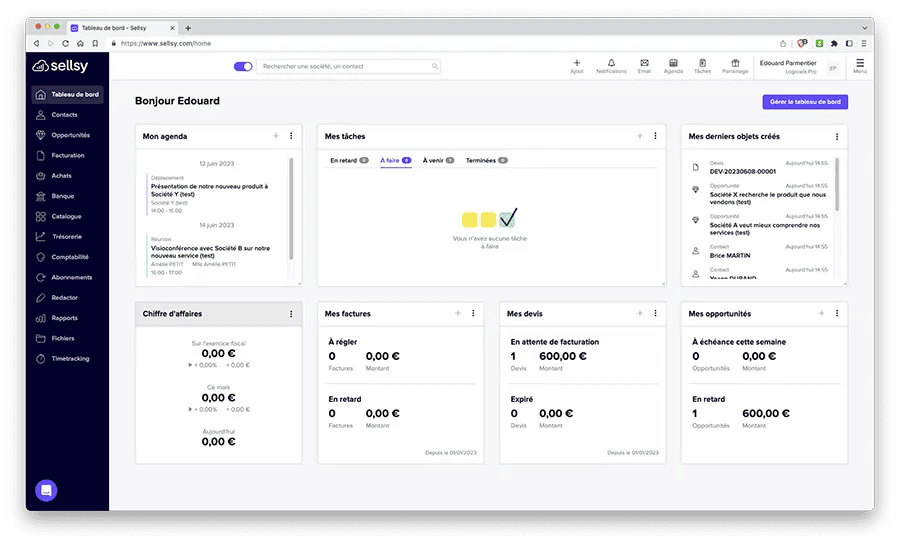
Improve the performance of your sales force by providing them with an appropriate CRM tool! You’ll increase the satisfaction of both your staff and your customers.
What is a CRM?
CRM (Customer Relationship Management) is software or a system that enables a company to manage its customer relationships. It is a technological tool that helps to centralize, organize and automate customer data and interactions.
A CRM generally offers the following functions:
- Customer database management: CRM allows you to store and organize customer information such as contact details, purchase history, previous interactions, preferences and demographic information.
- Tracking interactions: with your CRM you can track and record all interactions with your customers, whether by phone, email, social networks or in person. This gives sales, marketing and customer service teams an overview of past exchanges, so they can better understand customer needs and expectations.
- Sales opportunity management: it can also be used to track and manage sales opportunities, from the prospecting stage through to closing the sale. It keeps track of prospects, their preferences and ongoing sales activities, and facilitates collaboration between members of the sales team.
- Process automation: the tool can automate certain tasks and processes related to sales, marketing and customer service. This could include automatically sending follow-up emails, scheduling follow-up reminders, generating reports and analyses, or managing marketing campaigns.
- Analysis and reporting: used to generate reports and analyses of customer data. This can include performance measurements, sales forecasts, customer segmentation analyses, and other key indicators for making data-driven strategic decisions.

The main objective of your CRM is to improve customer relationship management by providing a complete overview of customer interactions and data. Thanks to your tool, you can optimize processes, offer a more personalized service, identify sales opportunities and build customer loyalty. A well-used CRM contributes to improving your company’s efficiency and results in terms of customer relationship management.
CRM integration by XPCloud
XPCloud has chosen to work with the Sellsy solution for customer CRM integration. Sellsy is a French company that offers a complete CRM suite designed for VSEs and SMEs. To install Sellsy, we proceed in several stages.
Analysis of your existing processes
Before integrating your CRM software, we need to assess your current customer relationship management processes. This audit will enable us to identify the weak points, inefficiencies and gaps in your existing system. Together, we can then define the objectives you want to achieve by integrating CRM software.
Defining your objectives
Once we’ve analyzed your existing processes together, the next step is to identify the areas in which you want to perform better using CRM software. For example, you might want to improve the personalisation of offers, optimize the tracking of sales opportunities, automate certain tasks or improve customer satisfaction. Setting specific, measurable and achievable objectives will help guide your customer relations strategy.
Involving your teams
The integration of CRM software generally involves several departments within the company: sales, marketing and customer service. Involving your teams right from the start of the process by organizing brainstorming workshops will make them aware of the benefits of implementing CRM software. In this way, we can gather their ideas and suggestions for customisation.
Customizing CRM software
One of the advantages of CRM software is its flexibility and its ability to adapt to the specific needs of your business. It can be customized to suit your processes, workflows and customer needs. To do this, we configure the settings, dashboards and reports to meet your organization’s requirements. If you use other systems, such as an e-commerce platform, we connect CRM to these tools to facilitate data sharing and workflows.
Put your customers at the heart of your sales strategies
Your CRM will be able to collect, store and analyze data about your customers. By exploiting this data, you can obtain in-depth information about your customers’ behavior and preferences. You can then use this information to personalize your interactions, segment your customer base, anticipate future needs and propose targeted offers. The analyses generated by CRM software can also help you to identify trends, opportunities and avenues for innovation.